 AsaaseYaa
Growing maize in Ghana
When to plant, how far apart, which variety, how to feed it and which pests to watch for. The same guide the AsaaseYaa app uses to plan your maize jobs day by day.
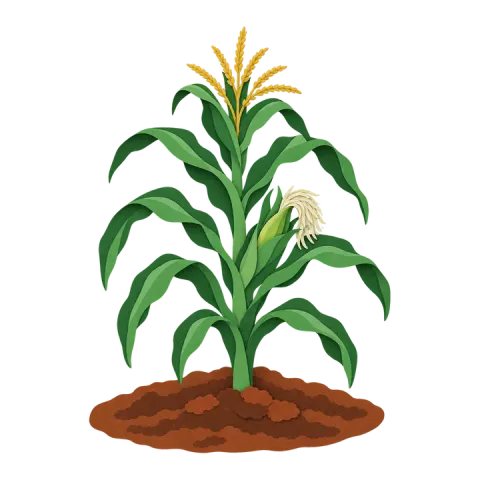
A primary staple across Ghana, grown heavily in the Forest-Savannah Transition zone (Techiman, Ejura) and the Northern Savannahs.
When to plant
| Where | Season | Months |
|---|---|---|
| South and middle belt | Season 1 | Mar – Apr |
| South and middle belt | Season 2 | Aug – Sep |
| Northern regions | Main Season | Apr – Jun |
In the app, the dates follow your region, and the jobs follow the rain forecast for your farm.
Getting the land ready
- Feeding: Compost or organic matter. If organic matter is available, incorporate before ridging. Wait for planting before applying mineral fertilizer.
- Weeds: Pre-emergence herbicide (Atrazine) after planting. Apply pre-emergence herbicide within 3 days of planting before weeds emerge. For organic: thorough land preparation removes most early weed pressure.
- Pests: Check for active termite mounds during land preparation. Treat if present — termites can severely damage young maize seedlings.
Varieties grown in Ghana
The most popular maize in Ghana. White grain, high protein (QPM), accepted at every market.
Matures fast (95 days) and copes with shorter rains — good for the Transition and Savannah zones.
Short-season white maize that handles dry spells. A safer bet in years when the rains come late.
Hybrid with strong yield under good conditions and proper fertiliser. Best where rains are reliable.
Quality Protein Maize (QPM) hybrid — strong yields with the protein quality buyers prefer.
Striga-tolerant white maize popular in the North — holds up where the parasitic weed Striga is a problem.
Extra-early yellow maize — the fastest to harvest, good for catching early markets or a short rainy spell.
Care through the season
Establishment
- Feed: NPK 15-15-15, 50 kg per acre. Broadcast at planting or place in furrow near seed.
- Weed: Weed at 2–3 weeks, repeat at 5–6 weeks.
- Watch for: Fall Armyworm (FAW), Cutworm, Termites. Scout every 3–4 days.
Vegetative growth
- Feed: Urea 46%, 25 kg per acre. Side-dress 5 cm from plant base, cover lightly with soil.
- Weed: One weeding at 5–6 weeks, then canopy closes.
- Watch for: Fall Armyworm (FAW), Stemborer, Aphids. Scout twice weekly.
Flowering
- Feed: Foliar micronutrient (zinc + boron), Foliar only if deficiency seen. Foliar spray in the morning.
- Weed: Once if needed.
- Watch for: Aphids, Ear-shooting insects, Silk-feeding pests. Scout twice weekly.
Grain fill
- Watch for: Grain weevil, Ear rots (Aspergillus), Rats/rodents. Scout weekly.
Pests and diseases
| Pest or disease | When it shows up |
|---|---|
| Fall Armyworm (FAW) | Establishment, Vegetative growth |
| Cutworm | Establishment |
| Termites | Establishment |
| Stemborer | Vegetative growth |
| Aphids | Vegetative growth, Flowering |
| Ear-shooting insects | Flowering |
| Silk-feeding pests | Flowering |
| Grain weevil | Grain fill |
| Ear rots (Aspergillus) | Grain fill |
| Rats/rodents | Grain fill |
Tap a name to see what it looks like and what to do. In the app, tap the leaf that looks like yours to see what is wrong. All pests: pest and disease library.
Harvest and storage
It is ready when:
- Husks are dry and papery, turning from green to straw-yellow
- Kernels are hard and dent when pressed with a thumbnail
- Silks are fully dried and dark brown
- Grain moisture is below 20% — test by biting: should be hard, not doughy
Hand-pick or manually snap cobs from stalks when husks are fully dry. For large fields, harvest in the cool of the morning to reduce heat stress on kernels.
- Sun-dry harvested cobs on clean tarpaulins for 5–7 days until moisture is below 13%
- Shell cobs after drying — hand-shell or use a pedal sheller for larger volumes
- Winnow to remove chaff and debris before storage
- Grade kernels: remove broken, discoloured, or mouldy grains
Store in hermetic bags (PICS or SuperGrainbag) at below 13% moisture to prevent weevil and Larger Grain Borer damage. Hermetic storage protects for 6–12 months without chemical treatment.
What to plant next
Plant soybean next season. Maize → soybean is the classic Ghanaian rotation. Bradyrhizobium fixation rebuilds N for the next cereal. Avoid cereal-on-cereal: depletes N + worsens striga / smut pressure.
General advice from crop guides for Ghana, including notes from a practising agronomist in Ghana. Check important decisions with an agronomist or your district agriculture office.
Get your maize jobs day by day
AsaaseYaa turns this guide into picture steps for your farm, with reminders. Free.