 AsaaseYaa
Growing okra in Ghana
When to plant, how far apart, which variety, how to feed it and which pests to watch for. The same guide the AsaaseYaa app uses to plan your okra jobs day by day.
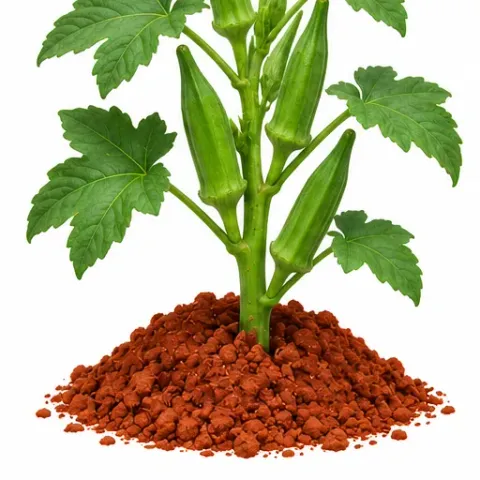
A fast-growing, high-value vegetable grown across all regions, particularly popular for smallholders near urban centres.
When to plant
| Where | Season | Months |
|---|---|---|
| South and middle belt | Major season | May – Jun |
| South and middle belt | Minor season | Sep – Oct |
| Northern regions | Rainy season | Jun – Jul |
In the app, the dates follow your region, and the jobs follow the rain forecast for your farm.
Getting the land ready
- Feeding: Well-rotted poultry manure or compost. Incorporate well-rotted poultry manure or compost into beds during land preparation to improve soil texture and organic matter.
- Weeds: Thorough land preparation; pre-emergence option after sowing. Good land preparation removes existing weed growth and prepares a clean seedbed for okra.
- Pests: Avoid continuous okra. Rotate with cereals or legumes and clear weed hosts before planting to reduce root-knot nematode and whitefly-borne virus inoculum.
Varieties grown in Ghana
Early-maturing, highly popular local selection — quick first harvest and reliable demand.
Popular local variety — compact plants well suited to smallholder beds.
Exotic spineless type with strong demand in urban markets.
Care through the season
Establishment
- Feed: NPK 15-15-15, 50 kg (1 bag) per acre. Broadcast and incorporate, or band 5 cm from the seedlings.
- Weed: Weed at 2–3 weeks, repeat at 5–6 weeks.
- Watch for: Flea beetles (Podagrica spp.), Aphids, Damping-off. Scout daily for first 2 weeks.
Vegetative growth
- Feed: NPK 15-15-15, 50 kg (1 bag) per acre. Ring or band placement 8 cm from plant base, cover with soil.
- Weed: One weeding at 5–6 weeks, refresh mulch.
- Watch for: Flea beetles (Podagrica spp.), Aphids, Whiteflies. Scout twice weekly.
Flowering
- Feed: Sulphate of Ammonia (or Potassium Nitrate), 50 kg (1 bag) per acre. Side-dress in a ring 10 cm from base, water in after.
- Weed: Once if needed.
- Watch for: Aphids, Whiteflies, Flea beetles (Podagrica spp.). Scout twice weekly.
Fruiting
- Feed: Sulphate of Ammonia (light), Light top-dress as needed during long picking. Side-dress in a ring, water in after.
- Weed: Minimal.
- Watch for: Whiteflies, Aphids, Flea beetles (Podagrica spp.). Scout every 3 days.
Pests and diseases
| Pest or disease | When it shows up |
|---|---|
| Flea beetles (Podagrica spp.) | Establishment, Vegetative growth, Flowering, Fruiting |
| Aphids | Establishment, Vegetative growth, Flowering, Fruiting |
| Damping-off | Establishment |
| Whiteflies | Vegetative growth, Flowering, Fruiting |
Tap a name to see what it looks like and what to do. In the app, tap the leaf that looks like yours to see what is wrong. All pests: pest and disease library.
Harvest and storage
It is ready when:
- Pods are young and tender, about 7–10 cm long
- Pods snap cleanly when bent — woody pods that bend without snapping are over-mature
- Harvest begins around 50–60 days after planting and continues for months
- Pick every 2–3 days so pods stay tender and the plant keeps setting new pods
Cut or snap pods with a short stalk attached, using a knife or scissors to avoid tearing the plant. Harvest in the cool of the morning. Pick every 2–3 days — do not let pods become woody.
- Sort immediately — discard woody, blemished, or pest-damaged pods
- Keep pods shaded and cool from the moment they are picked
- Pack loosely in ventilated baskets or crates to avoid bruising
- Sell within 1–2 days; slice and sun-dry any surplus (Nkuruma-gu / dried okra)
Highly perishable — fresh okra keeps only 1–2 days at ambient temperatures. For longer storage, slice pods and sun-dry them (Nkuruma-gu) to keep for months.
What to plant next
Plant a legume or cereal next. Okra → soybean/maize. Legume rotation rebuilds N; a cereal break interrupts the aphid/whitefly virus cycle okra shares with solanaceae. Avoid okra-on-okra or okra→solanaceae.
General advice from crop guides for Ghana, including notes from a practising agronomist in Ghana. Check important decisions with an agronomist or your district agriculture office.
Get your okra jobs day by day
AsaaseYaa turns this guide into picture steps for your farm, with reminders. Free.